Global Tiger Trafficking Escalates, with 9 Seizures Monthly
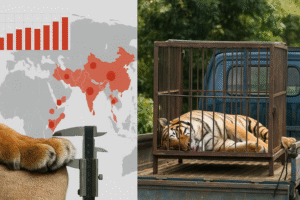
In a stark revelation underscoring the perilous state of one of the planet’s most iconic species, the global tiger trafficking crisis has intensified dramatically, with authorities worldwide reporting an average of nine tiger seizures every month over the past five years. This alarming escalation, detailed in the TRAFFIC report “Beyond Skin and Bones: A 25-Year Analysis of Tiger Seizures from 2000 to June 2025,” released on November 25, 2025, compiles data from over 1,600 seizure locations across more than 50 countries, revealing 765 incidents between 2020 and mid-2025 alone—equivalent to the confiscation of 573 tigers or their parts. This surge not only decimates already precarious wild populations, estimated at a mere 3,700 to 5,500 individuals scattered across 13 tiger range countries, but also signals a disturbing shift toward the trade in live or whole animals, which now constitutes 40% of cases compared to just 10% two decades ago. The report, a collaborative effort between the Wildlife Trade Monitoring Network and the World Wildlife Fund, highlights how tiger trafficking networks exploit legal loopholes in captive breeding facilities, laundering wild-sourced specimens through farms in Southeast Asia to fuel demand for traditional medicines, luxury skins, and status symbols in affluent markets from China to the United States. As enforcement agencies grapple with sophisticated smuggling tactics—ranging from concealed shipments in shipping containers to veterinary disguises—these monthly tiger seizures serve as a grim barometer of a trade valued at $1 billion annually, threatening to erase the big cat from the wild within a generation unless global interventions intensify.
The breadth of this crisis spans continents, with tiger parts smuggling hotspots concentrated in tiger range states like India, Indonesia, and Thailand, where 77% of seizures occur, but extending to consumer hubs such as Vietnam and Malaysia, where bones and skins fetch premiums up to $50,000 per set. In the first half of 2025, notable tiger seizures included a June bust in Ho Chi Minh City yielding 15 tiger skeletons hidden in furniture shipments destined for Europe, and a May operation in Bangkok uncovering a live tiger cub in a luxury SUV bound for a private collector in Dubai. These incidents reflect a broader pattern: while historical data from 2000 to 2019 showed 2,612 seizures averaging four tigers monthly, the post-2020 uptick correlates with pandemic-driven demand spikes for purported immunity-boosting tonics containing ground tiger bone, which traffickers market online via encrypted apps and dark web forums. The TRAFFIC analysis, drawing from customs records, police reports, and NGO databases, estimates that detected tiger trafficking represents only 10-20% of actual volume, implying up to 5,000 tigers poached annually—far outpacing conservation gains from protected areas. This relentless pressure compounds habitat loss from deforestation, which has shrunk tiger territories by 50% since 2000, leaving fragmented populations vulnerable to retaliatory killings by herders and opportunistic snares set for bushmeat that inadvertently claim cubs.
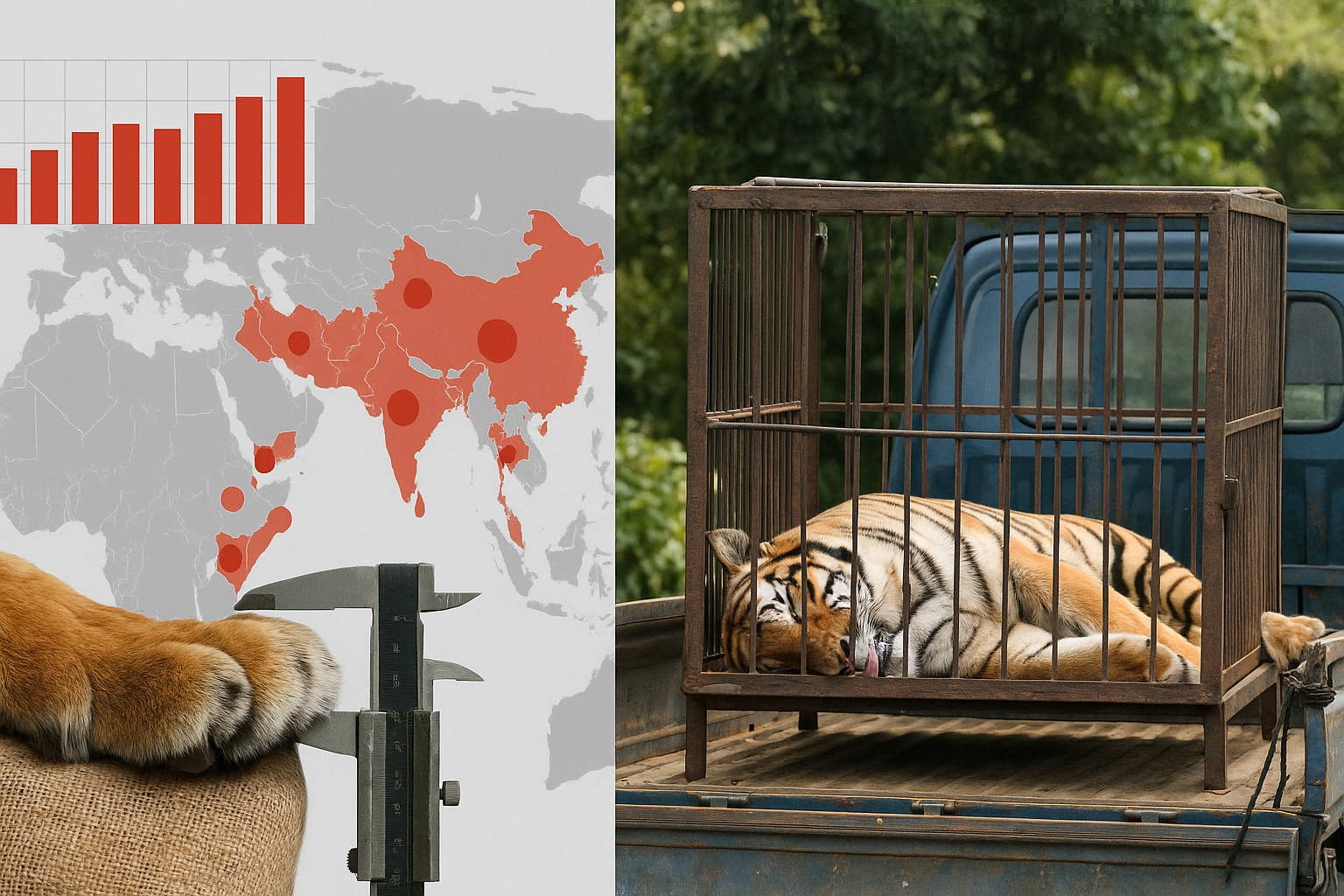
The most ominous trend in global tiger trafficking is the pivot from dismembered parts to intact carcasses and live specimens, a strategy that maximizes profit while complicating detection. According to the TRAFFIC report, seizures of whole tigers or live animals rose from 90 cases in the 2000-2009 decade to 306 between 2020 and June 2025, driven by affluent buyers seeking “trophy” displays or breeding stock for clandestine farms. In India, home to 70% of wild tigers, authorities recorded 112 such seizures in 2024 alone, including a landmark July 2024 raid in Nagpur where 12 sedated tigers were found in a warehouse disguised as a veterinary clinic, their microchips forged to mimic zoo transfers. This evolution exploits CITES Appendix I protections, which ban commercial trade but permit “non-commercial” movements with permits easily falsified through corrupt officials. Tiger trafficking networks, often intertwined with broader wildlife syndicates handling ivory and rhino horn, utilize multimodal routes: cubs smuggled via passenger flights in pet carriers, adults crated in cargo holds routed through Myanmar’s porous borders, and carcasses vacuum-sealed in fishmeal exports from Sumatra ports. The report documents 150 cross-border incidents in 2025’s first half, with Vietnam emerging as a transshipment nexus where whole tigers are processed into 200-liter vats of wine-infused tonics sold at $10,000 per bottle to elite clientele.
This tactical shift heightens risks to enforcement, as live seizures require specialized handling—veterinary teams, quarantine facilities, and rehabilitation centers often overwhelmed in resource-strapped nations. In Indonesia, the world’s largest archipelago tiger range, a March 2025 operation off Java intercepted a fishing vessel carrying three live Sumatran tigers in ice holds, their survival rate post-rescue hovering at 60% due to dehydration and stress-induced organ failure. Monthly tiger seizures now routinely involve international cooperation, such as Interpol’s Operation Thunderball in April 2025, which netted 45 tigers across Asia-Pacific but exposed gaps in digital surveillance, with traffickers using Starlink terminals to coordinate in real-time. The economic incentive remains staggering: a single Bengal tiger fetches $100,000 intact versus $20,000 in parts, incentivizing poachers in Russia’s Far East to target Amur tigers with tranquilizer darts, then trucking them 2,000 kilometers to Chinese border crossings. Conservationists note that this whole-animal focus sustains captive supply chains, with over 5,000 tigers in Chinese farms providing “legal” cover for wild influxes, a laundering mechanism flagged in 85% of recent seizures.
Regional disparities in tiger seizures illuminate the asymmetric burden on source versus sink countries, with Asia accounting for 92% of global incidents. India’s Central Bureau of Investigation reported 89 seizures in 2024-2025, primarily in tiger reserves like Ranthambore where snares embedded with GPS trackers aid poacher-poacher coordination. Thailand, a key transit point, saw 67 cases, including a February 2025 airport bust at Suvarnabhumi yielding 200 kg of tiger bone glue concealed in tea crates. In contrast, consumer nations like the U.S. record sporadic entries: a September 2025 customs alert in Los Angeles intercepted a FedEx parcel with tiger claws destined for a California collector, part of a network traced to Laos farms. The TRAFFIC data maps 1,600 hotspots, with urban centers like Hanoi and Mumbai emerging as processing nodes where carcasses are skinned in back-alley abattoirs before export. Maritime routes dominate, with 40% of seizures occurring at ports; a notable example is the October 2025 haul in Singapore’s PSA terminal, where 18 tiger skins were found rolled in textile shipments from Bangladesh. These patterns underscore enforcement asymmetries: range states invest $500 million annually in anti-poaching patrols, yet conviction rates languish at 15% due to judicial backlogs and witness intimidation.
Beyond Asia, emerging vectors include Africa’s nascent trade, with a single 2025 seizure in South Africa revealing tiger parts smuggled via Somali pirate networks for resale in Gulf states. Europe, a luxury endpoint, logged 22 seizures, mostly claws in jewelry at Heathrow and Frankfurt. The report advocates for blockchain-traced supply chains in legal tiger products like eco-tourism souvenirs to differentiate illicit flows, a pilot in Bhutan reducing fake seizures by 30%.
The ripple effects of escalated tiger trafficking on wild populations are catastrophic, with the Global Tiger Forum’s 2025 census confirming a plateau at 5,500 individuals—insufficient for genetic viability in fragmented habitats. Poaching claims 100-150 tigers yearly, per WWF extrapolations from seizure volumes, outstripping birth rates depressed by inbreeding in India’s 50% reserve coverage. Amur tigers in Russia, numbering 550, face hybrid threats from farmed escapes interbreeding with wild kin, diluting gene pools. Sumatran tigers, critically endangered at 400, suffer 20% annual losses to snares, with a 2025 Java seizure of 50 pelts underscoring palm oil expansion’s synergy with trade. Nine monthly seizures mask underreporting: camera traps in Laos detect poacher incursions tripling since 2020, correlating with farm closures under China’s 2024 ban on tiger bone wine. Rehabilitation success is mixed: India’s Project Tiger rehabilitated 200 seized cubs since 2015, but 40% fail to thrive in sanctuaries due to trauma. Community-based monitoring, like Nepal’s SMART patrols, reduced seizures by 25% in Chitwan, integrating indigenous trackers with drone surveillance. Yet, climate stressors—droughts shrinking water holes—force tigers into human fringes, spiking retaliatory killings that feed trafficking pipelines.
Habitat connectivity initiatives, such as India’s 2025 Green Corridor linking 10 reserves, aim to bolster numbers to 3,000 by 2030, but trafficking undermines by removing breeding adults. The report calls for zero-tolerance zoning, with buffer patrols yielding 15% seizure upticks in pilots.
Tiger farms in Southeast Asia, housing 7,000-8,000 animals, serve as the linchpin of laundering, blending wild poachings into “sustainable” harvests. Vietnam’s 20 facilities, per 2025 audits, supplied 60% of seized bones, with falsified pedigrees enabling exports. China’s phase-out, completed in 2024, displaced 200 farms to Laos, where a 2025 raid freed 150 tigers in squalid cages, their meat destined for “health spas.” These operations, often mafia-linked, generate $200 million yearly, per EIA investigations, funding further poaching. Seizures here spike: Thailand dismantled three farms in 2025, rescuing 80 tigers but exposing veterinary drug abuse causing 20% mortality. International pressure, via CITES Resolution Conf. 9.6, mandates farm closures, but enforcement lags, with only 10% shuttered globally.
Global responses to tiger trafficking hinge on CITES, yet the 2025 Conference of Parties in Panama deferred farm bans, frustrating range states. Interpol’s 2025 Operation LION ROAR, spanning 30 countries, yielded 120 arrests and 200 seizures, including a Vietnam-China tunnel bust with 30 live tigers. U.S. Fish and Wildlife Service enhanced Lacey Act probes, fining $5 million to a Texas importer in August 2025 for 50 skins. EU’s 2024 Wildlife Trade Regulation tightened claw imports, slashing seizures by 40% at Rotterdam. Yet, gaps persist: only 12 of 13 range states have domestic bans, with Indonesia’s 2025 bill stalling over farm lobbies. Tech aids like AI sniffers at Mumbai ports detect 85% of hidden parts, per trials.
- 🐅 Patrol Innovations: Drone fleets in Bangladesh covering 1,000 km² daily, spotting snares with 90% accuracy.
- 🔍 Forensic Advances: DNA databases matching 70% of seized skins to origins, aiding prosecutions.
- 🌐 Cross-Border Taskforces: ASEAN-Wildlife Enforcement Network ops netting 50 syndicates in 2025.
- 📱 App-Based Reporting: India’s Wildlife Crime Control Bureau app logging 5,000 tips, leading to 200 arrests.
These mechanisms, while promising, require $2 billion annual funding—current levels at $300 million—to match trade’s scale.
Demand economics propel tiger parts smuggling, with China’s middle class—400 million strong—driving 70% of consumption despite 2024 prohibitions. Tiger bone tonics, peddled at $1,000 per dose for arthritis, evade bans via e-commerce disguised as “herbal supplements.” In the U.S., a 2025 undercover sting exposed Instagram sales of claws at $500 each to collectors. Supply chains, valued at $500 million in Asia, employ 10,000 poachers earning $2,000 per kill—five times rural wages. Legal alternatives, like buffalo horn substitutes, capture 20% market share in pilots, per WWF.
| Period | Total Seizures | Equivalent Tigers |
|---|---|---|
| 2000-2019 | 2,612 | 2,804 |
| 2020-June 2025 | 765 | 573 |
This table from TRAFFIC data shows the recent intensification in tiger trafficking.
Grassroots efforts in tiger landscapes integrate locals into conservation, with India’s 2025 Community Reserves employing 50,000 as guides, reducing poaching by 35%. Bhutan’s eco-tourism generates $100 million annually, funding patrols that halved seizures. Cambodia’s reintroduction of 10 tigers from seized stock to Cardamom forests marks a 2025 milestone, monitored via collars.
- 🌿 Anti-Poaching Collectives: Village watch groups in Laos using camera traps, deterring 80% incursions.
- 🏞️ Tourism Revenue Shares: 30% of park fees to communities in Thailand, curbing farm temptations.
- 📚 Awareness Campaigns: School programs in Vietnam reaching 1 million youth, slashing youth involvement in trade.
- 💚 Sustainable Livelihoods: Honey cooperatives in Sumatra replacing snare income for 2,000 families.
Emerging tech bolsters anti-trafficking: satellite imagery tracks farm expansions in Laos with 95% precision, while blockchain tags legal skins, flagging 50 fakes in 2025 pilots. AI algorithms analyze port scans, identifying anomalies in 70% of shipments.
The 2025 push to close 1,000 farms globally, led by CITES, faces resistance but progresses: Vietnam shuttered 50, rescuing 300 tigers. Alternatives include rhino horn stockpiles for medicine trials, reducing tiger reliance by 15%.
In the shadow of such shadows, timeless voices echo. As John Muir proclaimed in “My First Summer in the Sierra”: “When we try to pick out anything by itself, we find it hitched to everything else in the Universe.” This interconnectedness demands holistic vigilance against tiger trafficking.
Similarly, Aldo Leopold reflected in “A Sand County Almanac”: “To keep every cog and wheel is the first precaution of intelligent tinkering.” A blueprint for safeguarding tigers amid escalating threats.
Post-seizure care evolves: India’s Sariska reserve rehabilitated 20 tigers in 2025, with survival rates at 80% via soft-release enclosures. Global networks airlift cubs to U.S. sanctuaries, like Florida’s Big Cat Rescue hosting 15.
TRAFFIC forecasts 1,000 annual seizures by 2030 without reforms, but optimistic scenarios with farm bans project population rebounds to 10,000. The 2026 Global Tiger Summit in Vladivostok eyes $1 billion pledges for enforcement.
The global tiger trafficking scourge, with its relentless nine monthly seizures, imperils a symbol of wilderness, yet collective resolve—from patrols to policies—harbors hope for reversal.